The Post Labor Dev Era
Table of Contents
The Post-Labor Dev Era
AI was a hype machine in 2025, and I don’t expect that to stop. If you open LinkedIn, you’ll see it everywhere (and yes, I’m contributing to it too).
What’s more interesting to me is that most people still don’t feel the hype in their daily work. That’s not because the tools aren’t real. It’s because adoption is slow for two reasons:
- Human inertia: changing habits is hard.
- Bureaucratic inertia: companies move slowly, even when the tools exist.
And bureaucracies are made of people, so those forces compound.
I’m writing this because I’ve spent the last few weeks going deep on newer “agentic” dev workflows — agents, subagents, skills, plugins, toolchains, and the general ecosystem that’s grown up fast. My setup today is already different from what it was at the start of 2025, and I’m pretty sure I’ll say the same thing again a year from now.
This post is my attempt to describe the shift I think is underway, mostly from a software lens, but I think it generalizes.
The old world
In the pre-AI world, ideas were cheap and execution was expensive.
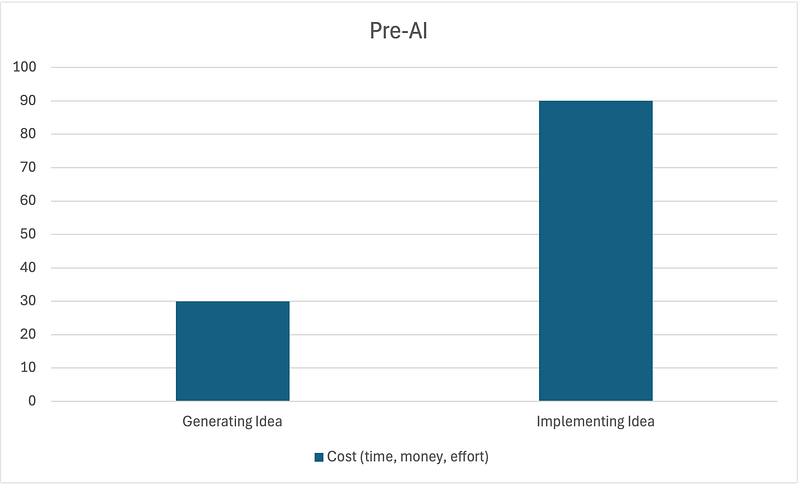
If you work in tech, you’ve probably had the awkward experience where someone says, “I have an app idea,” and then asks you to help build it. The problem usually isn’t the idea. The problem is that execution requires:
- time
- skilled labor
- coordination
- money (or favors)
Most programmers don’t want to work for free (reasonable), and hiring good people is expensive (also reasonable). So a lot of ideas died in the gap between “this would be cool” and “this exists.” That gap acted like a filter. Not a fair one, but a real one.
What changed
AI doesn’t make execution free, but it does something important: it reduces the cost of getting started and iterating.
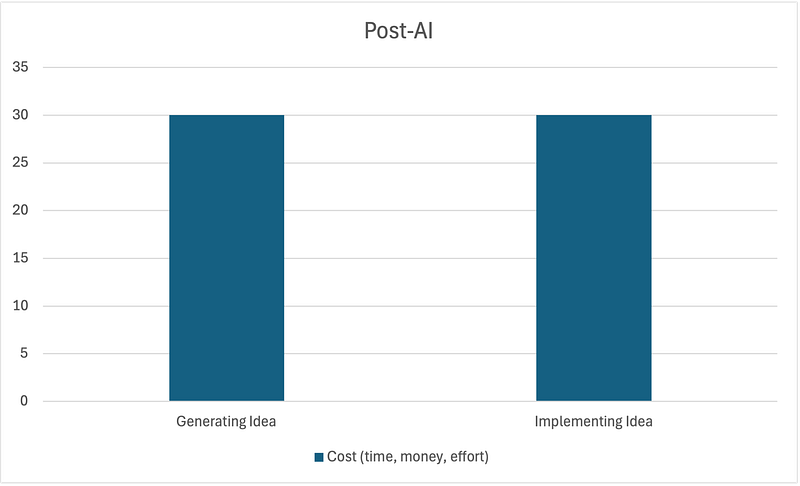
A lot of the things that used to slow you down — scaffolding projects, stitching together docs, writing glue code, generating drafts, debugging obvious stuff, getting a first version out — are cheaper now.
In an AI-heavy world, the scarce thing isn’t “can you produce output?” Output is becoming abundant. The scarce thing becomes:
- Taste: choosing the right problems, making good decisions
- Ideas: generating solutions that actually matter
- Follow-through: shipping, iterating, finishing
That’s the “new scarcity” I think people are underestimating. And it will have some pretty large impacts in 2026 and beyond.
New Winners and Losers
In the pre-AI world, people both having ideas and executing on them always won, but the costs of being able to do so (via labor) meant that only those with connections or wealth were able to really execute on them effectively. Your friend with a great app idea was pretty screwed unless you wanted to help him and pay for your expensive labor.
In this new world, people who have great ideas now have the ability to see those ideas through by having labor costs of coding, design, marketing, basically everything going way down. This will upset the existing power structure and create a new class of winners, who will be the people who adopt AI and are able to use it extremely quickly.
Examples of winners
- Startups who are AI-first and advocate for as much AI use as possible for idea generation and execution
- Individuals who are able to orchestrate these tools together to create MVPs
- Large companies who can break through bureaucratic red tape and adopt AI throughout large organizations
Examples of losers
- People whose value is mostly expensive manual output and who don’t adapt
- Organizations that resist AI for cultural/status reasons
- People who confuse activity with progress (working hard, aiming poorly)
I just want to clarify that this doesn’t mean cost of labor needs to come down necessarily. What it will mean though, is that if you cannot translate your labor into using AI tools to do it much faster, you will be left behind. It also means that the cost of people who consistently have good ideas will go up dramatically.
How will this work in practice?
- Your friend who always had good ideas but was stuck in a job because the cost of execution was so high, will start to rise up dramatically due to having learned and use AI to arbitrage those costs. People will break ceilings.
- People will leave comfortable, stable career paths to pursue entrepreneurship at a much greater rate than before.
- Creative destruction will begin to accelerate much faster across all levels of business (giant companies and mid-level companies will have value sucked from them by smaller ones).
It Will Pop the Bubble
Most think that we are in a speculative bubble and that it will pop, that’s consensus. But the take that it will actually be this idea/labor cost consolidation that does it is the point I want to drive across.
We have had some early companies see this revolution early (Cursor for example) and their value has gone to insane levels as a result. Anthropic and OpenAI are some other examples.
In a world where AI can essentially do a lot of work for us that these companies are hoarding, I struggle to see them maintaining these valuations.
For example, one hot take I have is that Neovim will become a fully-fledged IDE in 2026. This is due to many people having ideas for Neovim plugins but haven’t done anything about it because:
- Lua is pretty useless outside of the gaming industry (seriously, when have you ever gotten a highly paid job opportunity doing Lua?)
- The API is terribly documented (as is Neovim)
- Information is decentralized and spread around the internet, the development experience is not great
All costs that AI can reduce greatly because it is so good at solving these problems.
I’m channeling my inner Michael Burry on this one, but I fail to see how Cursor can maintain its valuation when you can literally just code all of the features you want from Cursor into Neovim, by using Cursor to do it. And then being able to use that IDE for free.
Startups who have high valuations and high prices for their products will need to develop features at a much faster pace and higher-quality than newcomers. If this doesn’t happen, competition will drive prices down dramatically.
Luddites Will Be Punished
Just to make something clear, I am not saying that one should only use AI and not really learn anything, that would be shortsighted. But at the same time, insisting that AI “isn’t really that good” and resisting it will be damaging to your career over time, and those damages will increase exponentially.
The truth is somewhere in between: you will have to use AI for work on a daily basis but still have to learn what it’s doing.
In 2026, the two extreme sides:
- I don’t use AI because I am in denial about how good it’s getting and don’t want to be dumbed down
- I only use AI and don’t learn anything
Are now both in the same bucket, and that will be a tough realization for a lot of people.
However, if you get really good at using AI tools and also comprehending what it is doing and learning from it, you will pull ahead.
Conclusion
We are in a golden age of AI use right now, mainly due to VCs subsidizing the costs of these tools. A lot of power users (myself included) are definitely losing these companies money, and I expect the costs of these tools to rise over time.
That means that right now is the best time to be figuring out how to effectively use and orchestrate all of this tooling, so you will have the knowledge on how to make it more efficient when prices inevitable rise (investors will want to be paid back).
If you resist, you risk having to onboard after the price gates go up, which means your learning rate will be permanently behind most other people. After which point, maybe the idea and labor costs start to go back to the pre-AI world again.
I hope you enjoyed this article, and have a great 2026!
All opinions are my own.